
Which cat to choose if you live in a flat
Unlike dogs, cats can live happily in a flat their whole lives. What they cannot do is live in a boring flat. Size matters little; energy, the need for company and what you do with the space matter a great deal.
Flat size matters less than you think
A cat does not measure its home in square metres, but in routes, heights and hiding places. A 50 m² flat with shelves, tall scratching posts, a safe window for watching the street and someone who plays with it every day is a better home than a big detached house where it is bored. What it needs is to be able to climb, hide, scratch, look outside and hunt, even if the prey is only a feather wand. That is why the useful question is not whether a cat fits in your flat, but whether your flat, with a few changes, can be an interesting place for a cat, and whether you have the time to play with it.
Energy, the factor that weighs most
Some cats spend sixteen hours a day asleep and are content with two play sessions, while others need constant activity and, if they do not get it, go looking for it in your curtains. Wild-looking breeds such as the Bengal, the Savannah, the Abyssinian or the Ocicat tend to be very active, curious and demanding: they can live in a flat, but they need a lot of enrichment and a lot of play, and they are not the easiest option. Kittens and young cats of any kind are also a whirlwind. If you want a calm life together in a small space, a low or medium-energy adult is a better choice.
Breeds that usually cope best
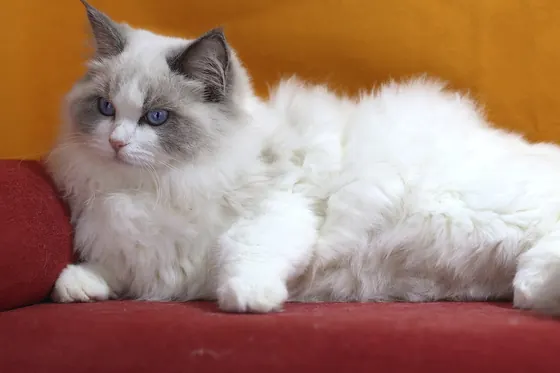
Among breeds, those usually recommended for flats are the ones with a calm, adaptable nature: the British Shorthair, the Ragdoll, the Birman, the Exotic, the Chartreux or the Russian Blue, the last of these a little shy with strangers. The Persian is a real homebody, but you have to allow for daily brushing and for the health problems that come with very flat faces. Yet the best option for a flat is not on any breed list: it is an ordinary adult shelter cat whose foster carer tells you it is calm, likes sleeping in the sun and does not need to go out. That information is worth more than any label.
Noise: meowing and the neighbours
In a flat with thin walls, meowing matters. Siamese and Oriental cats are famous for being very chatty, with a powerful voice they use at all hours to ask, comment or complain. An unspayed female in heat yowls loudly for days, especially at night, and so does an entire male. Neutering, which Spanish law requires before six months, takes care of that part. Kittens and bored cats tend to race up and down the hallway at night, which can be heard quite clearly in the flat below. A good play session before bed, followed by dinner, goes a long way towards a quiet night.
Balconies and windows come first
A flat is only safe for a cat if its windows and balconies are. Falls from height are so common in cities that vets have a name for it, high-rise syndrome: the cat chases a bird or an insect, loses its balance or jumps, and falls. Although cats sometimes survive falls of several storeys, they break their jaw, palate or legs, and a fall from a first or second floor can be just as serious. The solution is cat netting on the balcony and on any windows you open, and watch out for tilt-and-turn windows, which trap the cat that tries to squeeze out through the gap. On top of that, in Spain Law 7/2023 (the animal welfare law) bans keeping cats on terraces and balconies on a regular basis.
Indoor life, yes, but a rich one
A flat cat needs its home to offer what the outdoors would otherwise give it. Height: shelves, a floor-to-ceiling cat tree, the top of a wardrobe, so it can watch from above and move around without touching the floor. Hiding places: boxes, cave beds, a gap under the bed. Scratching posts spread around the home, vertical and horizontal. A safe window with a comfortable spot for watching the street, which for a cat is television. Daily play that imitates hunting, ending with it catching the prey. And food it has to search for, in puzzle feeders or scattered around the home. With all that, a flat makes a wonderful territory.
One cat or two?
If you spend many hours away from home, two cats that get on usually cope better with flat life than one on its own, because they keep each other company, play together and tire each other out. The simplest way to get it right is to adopt two siblings or two cats that already live together in the same foster home. The space needed does not double, but some things do: one litter tray per cat plus one, two or more feeding and water stations, and enough heights and hiding places for each cat to have its own spot. If the flat is very small and one of the cats is very territorial, tensions may arise; if your current cat is older and calm, it may prefer to remain an only cat.
The litter tray in a small flat
It is the detail most often neglected in small flats. The litter tray has to be somewhere quiet and accessible, away from food and water, and not in a corner the cat can only reach by walking past the washing machine while it is running. In a flat, the temptation is to put it in the bathroom with the door half closed or on an enclosed balcony: if the cat cannot always get to it, it will find somewhere else. An unscented clumping litter, scooped every day, barely smells. And even if the flat is small, the tray should not be: big, and open or covered depending on what the cat will accept.
Before you choose
Check that your tenancy agreement or the building's residents' association does not ban pets, and that you will be allowed to fit netting. Think about how many hours the home is empty and whether you will be able to play with the cat every day. Choose by energy rather than breed: a calm adult for a calm life, and a young, active cat only if you have plenty of time to give it. And if in doubt, ask a rescue: many have cats that have already lived in flats and can recommend one knowing what they are like. A well-prepared flat and a well-chosen cat make one of the happiest combinations there is.
Almost any cat can live in a flat if the home has heights, hiding places, scratching posts, a safe window and daily play. Choose by energy rather than breed: a calm adult is the safest bet. And fit netting on balconies and windows before it arrives.
Educational content from Michipedia, translated from the Spanish original. It does not replace the advice of a vet or a feline behaviour specialist. Every cat is an individual.