
My cat is limping: the causes, what to check at home and when it is urgent
Cats hide pain so well that a visible limp is already an important sign. Sometimes the cause is trivial, such as an ingrown claw; other times it is an abscess forming, a fracture after a fall or, at worst, a blood clot that paralyses the hind legs within minutes.
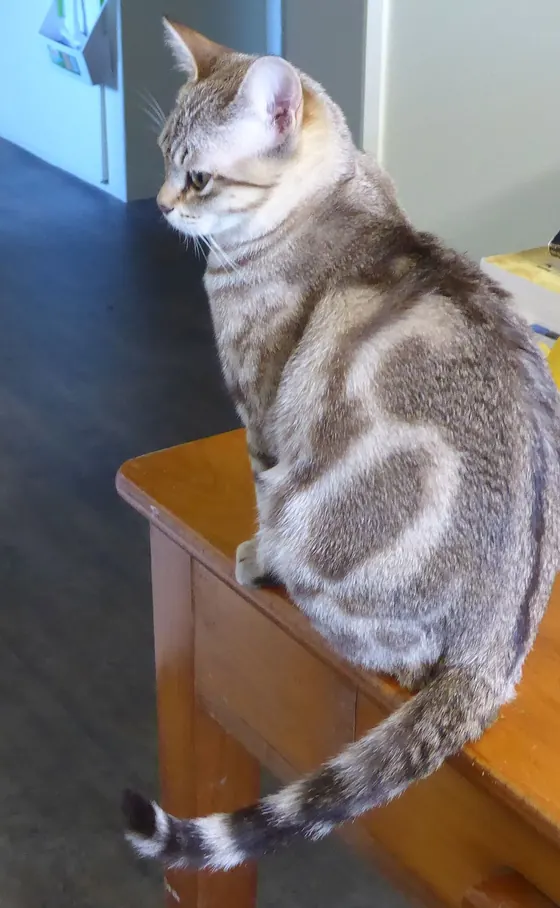
How a cat limps
A limping cat may put the leg down carefully, rest only its toes on the ground or not use the leg at all. Sometimes the lameness is subtler: it stops jumping onto its high spots, gets onto the sofa in two stages, lies down more, licks one leg a lot or pulls away when you touch a particular area. In older cats you often see no limp as such, but stiffness on getting up or a slower walk. Watch which leg it is: if it is a front leg, the cat dips its head when it puts weight on the sound leg; if it is a hind leg, its hips move oddly. Filming the cat walking down the hallway helps a lot at the clinic, because many cats freeze there.
What to check at home (carefully)
If the cat allows it, check the leg calmly, in good light and, if necessary, wrapped in a towel with someone helping. Look at the pads for cuts, burns or anything stuck in them, such as a grass awn, glass or a splinter. Check the claws: in older or inactive cats they can grow so long that they curl round and dig into the pad. Feel gently for warm, swollen or painful areas, and look for small puncture wounds hidden in the fur, typical of a bite. If the cat growls, hisses or tries to bite, stop: pain makes any cat bite, and a cat bite on a person becomes infected very easily.
The most common cause in cats that go out: abscesses
In a cat with outdoor access, a limp that appears without an obvious fall is usually a bite from another cat. The canine teeth inject bacteria under the skin, the wound closes on the outside, and two to four days later a hot, painful swelling appears, sometimes with fever and lethargy. If it bursts, strong-smelling pus comes out. It needs to go to the vet to be drained and treated with veterinary antibiotics and pain relief. Fights are also the main route of transmission of feline immunodeficiency virus (FIV), so after a bite it is worth talking to your vet about testing a few weeks later. Neutering greatly reduces fighting and, with it, abscesses.
Falls, knocks and fractures
Cats do not always land on their feet, and when they do they do not always come out unharmed. Falls from balconies and windows, known as high-rise syndrome, cause fractures of the legs, jaw and palate and chest injuries, sometimes from modest heights. Being hit by a car can break the pelvis or a leg. At home, a misjudged jump or a door closing on the tail or a leg can also cause injury. If the leg is deformed, hangs loose, the cat will not put any weight on it or there is an open wound with bone showing, it is an emergency. Transport it in the carrier, without trying to splint the leg or set the bone yourself.
The emergency you need to know about: thromboembolism
If your cat suddenly cannot move one or both hind legs, cries out in pain, the legs feel cold and the pads look pale or bluish, and perhaps it is breathing fast, it probably has an arterial thromboembolism (often called a saddle thrombus): a clot that formed in the heart and has lodged at the end of the aorta, cutting off the blood supply to the legs. It is almost always the result of heart disease, often a hypertrophic cardiomyopathy that had not been detected. It is a medical emergency with intense pain: go to the emergency vet immediately. The prognosis is guarded and depends on the cause and whether one or both legs are affected.
Arthritis and chronic pain in older cats
Arthritis is greatly underdiagnosed in cats: X-ray studies show degenerative changes in a large proportion of older cats, but few owners notice a limp. Instead of limping, the cat jumps less often and less high, uses intermediate steps, pees or poos outside the tray because getting into it hurts, grooms its back and rear end less, sleeps more and is more irritable when touched. Effective, safe treatments for cats are now available, including a monthly monoclonal antibody injection for arthritis pain, as well as veterinary anti-inflammatories, weight control and adaptations at home. The subject is covered in depth in the article on arthritis.
Other causes
Ingrown claws, seen mainly in older cats and in polydactyl cats with extra toes. Burns on the pads after stepping on a hob or very hot tarmac. Insect stings, which cause sudden swelling. Sprains and ruptured knee ligaments, less common than in dogs but possible, especially in overweight cats. Patellar luxation, to which some breeds such as the Devon Rex or the Abyssinian are predisposed. Joint infections, bone tumours and some neurological problems complete the list. And in breeds such as the Scottish Fold, the cartilage defect linked to the folded ears causes chronic joint pain.
What the vet will do, and what it costs
The vet will watch the cat walk, if it allows it, and then feel each leg for pain, heat, swelling, instability or wounds, with sedation if the cat will not tolerate the examination. X-rays are the basic test for fractures, dislocations and arthritis. If a clot is suspected, the vet will check the pulse in the hind legs and run heart tests. As a guide in Spain in 2026: consultation, €40 to €60; X-rays, €60 to €150; sedation, €40 to €100; draining an abscess, €60 to €200; surgery for a fractured femur or tibia, €800 to €2,000 depending on complexity; a thromboembolism with hospitalisation, from €600 to over €2,000.
What not to do
Do not give it human painkillers of any kind: paracetamol is fatal to cats, and ibuprofen, naproxen or diclofenac can cause ulcers and kidney failure. Not even dog anti-inflammatories are suitable for a cat, because the dosing and some of the active ingredients differ. Do not bandage it yourself, because you could cut off the circulation. Do not force it to walk to “see if it wears off”. And do not wait a week to see if a cat improves when it will not put the leg down at all, has a fever or is subdued. On the other hand, a very mild limp in a cat that is otherwise well can be watched for a day with rest before you see the vet.
Prevention
Safety netting on windows and balconies, without exception: it is the measure that prevents the most feline fractures in Spanish cities. Neutering, which reduces fights and abscesses. Claws checked every few weeks, especially in older cats. An ideal weight, which protects the joints. A home adapted for the older cat: ramps or steps up to its favourite spots, a low-sided litter tray, comfortable beds. And regular vet check-ups: in breeds predisposed to cardiomyopathy, or in any cat with a heart murmur, an echocardiogram can detect the heart problem before it produces a clot.
In a cat that goes outdoors, a limp without a fall is usually a bite abscess. Check the pads and claws carefully, without forcing. If it suddenly cannot move its hind legs and they are cold, it is a blood clot and an emergency. Never give it human painkillers.
Educational content from Michipedia, translated from the Spanish original. It does not replace the advice of a vet or a feline behaviour specialist. Every cat is an individual.