
My cat has watery or gunky eyes
A little dark sleep in the corner of the eye in the morning is normal. An eye that waters non-stop, that the cat squints or keeps closed, that turns red or cloudy, is not. With eyes, unlike almost everything else, a few hours can make the difference between seeing and not seeing.
What is normal and what is not
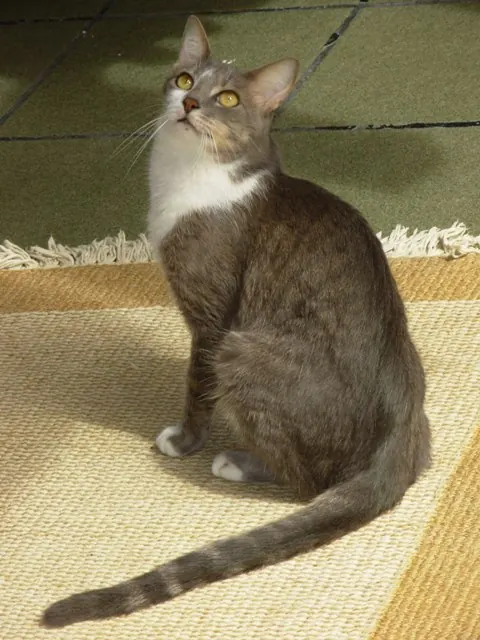
Many cats have a small, dry, brown or reddish crust in the inner corner of the eye in the morning. If it wipes away easily, the eye is open, bright and not red and the cat is not rubbing it, there is nothing to do except clean it with damp gauze. What deserves attention is constant watering, yellow, green or thick discharge, redness of the white of the eye or the conjunctiva, swollen eyelids, the cat squinting or closing one eye, pawing at it, the third eyelid showing (a white membrane in the inner corner), or the eye looking cloudy, with the pupil different from the other side.
Conjunctivitis: almost always infectious
In cats, conjunctivitis very often has an infectious cause, and feline herpesvirus type 1 is the main culprit, alone or together with Chlamydia felis and Mycoplasma. It is typical in kittens and in cats adopted from shelters or colonies, often along with sneezing. The conjunctiva becomes red and swollen, there is watering and discharge, and it usually starts in one eye and spreads to the other. Chlamydia causes very swollen, persistent conjunctivitis. Because herpes stays latent, it can return with stress. It is treated with veterinary eye drops or ointments depending on the cause, sometimes antivirals and sometimes antibiotics, and it is important that the vet confirms there is no ulcer before certain products are used.
Corneal ulcers: pain and urgency
The cornea is the clear layer on the surface of the eye. A scratch in a fight, a foreign body or herpesvirus itself can cause an ulcer: the cat squints, closes the eye, waters a lot and is bothered by light. The vet diagnoses it in minutes with fluorescein drops that stain the damaged area green. A superficial ulcer treated properly heals in days; a deep or infected one can perforate the eye. That is why a closed, painful eye is a same-day visit, not something to leave until the weekend. In Persians and Exotics there is also corneal sequestrum, a brown or black spot on the cornea that usually needs surgery.
Flat-faced cats: chronic tear staining
In Persians, Exotics, Himalayans and other very flat-faced cats, constant watering that stains the skin under the eyes reddish brown is common. The cause is anatomical: the tear ducts are kinked or squashed by the shape of the skull and tears overflow instead of draining into the nose, on top of very exposed eyes, facial folds that rub the cornea and sometimes eyelids that roll inwards (entropion). It cannot be cured, but it can be managed: clean the face and folds daily with damp gauze and dry them well afterwards, and have regular eye checks. If the watering suddenly increases, becomes thick or the cat squints, see the vet.
Uveitis: the eye that warns of something else
Uveitis is inflammation inside the eye. It looks like a cloudy or hazy eye, sometimes with a reddish or brown tinge to the iris, a smaller pupil than normal, a painful eye and watering. In cats, it is often a clue to a body-wide disease: feline infectious peritonitis (FIP), FeLV or FIV, toxoplasmosis, other infections or lymphoma. So, as well as treating the eye, the vet will request blood tests and infectious disease tests. It is urgent, because without treatment it can lead to glaucoma, cataracts or blindness.
Sudden blindness in an older cat
An older cat that suddenly bumps into furniture, cannot find the food bowl or has very dilated pupils that do not close in the light may have a retinal detachment from high blood pressure, which in cats often comes with chronic kidney disease or hyperthyroidism. Sometimes blood can be seen inside the eye. It is an emergency: if blood pressure is brought down quickly, some cats regain a degree of sight. That is why measuring blood pressure is recommended at check-ups for older cats, just as for people.
What to do at home
Clean discharge with sterile gauze moistened with saline, from the inside outwards, one piece for each eye so you do not carry infection from one to the other. Do not use cotton wool, which leaves fibres, or chamomile, which can irritate and leave residue. Above all, do not put in any eye drops you have at home, yours or another animal's: those containing corticosteroids, applied to an ulcer, can make it deepen until the eye perforates. If the eye is itchy and they paw at it, a cone can stop them doing more damage until you get to the vet. If they are also sneezing and have stopped eating, follow the advice for cat flu.
When it is a same-day emergency
Go the same day if the cat keeps an eye closed or squints a lot, if the eye is cloudy, very red or has blood inside, if the pupils differ from each other, if one eye looks bigger or more prominent than the other, if they have been scratched or hit, if they suddenly cannot see, or if a kitten has eyelids stuck together with pus. Mild conjunctivitis with the eye open and the cat bright can wait for a booked appointment in a day or two, while you clean with saline.
What the vet will do and what it costs
An eye examination with a light, a fluorescein test to look for ulcers, sometimes a Schirmer tear test to measure tear production and a measurement of eye pressure to rule out glaucoma. For uveitis or blindness: blood pressure measurement, an examination of the back of the eye, blood tests and infectious disease tests. As a guide in Spain in 2026: consultation with fluorescein, 40 to 70 €; consultation with a veterinary ophthalmologist, 70 to 130 €; tonometry, 20 to 40 €; veterinary eye drops, 10 to 30 €; surgery for corneal sequestrum or a deep ulcer, 500 to 1,500 €.
A dry crust in the morning is normal. A closed, painful, cloudy or very red eye, or sudden blindness, is a same-day emergency. Clean only with saline and gauze, one piece per eye, and never use eye drops from home: those with corticosteroids can perforate an ulcer.
Educational content from Michipedia, translated from the Spanish original. It does not replace the advice of a vet or a feline behaviour specialist. Every cat is an individual.