
Flat-faced cats: what to know before getting a Persian or an Exotic
Flat-faced cats have a very sweet look and a calm temperament that people love. They also have health problems that come directly from the shape of their face, just like brachycephalic dogs. This is not about loving them less, but about knowing beforehand, so you can choose well and care for them better.
What feline brachycephaly is
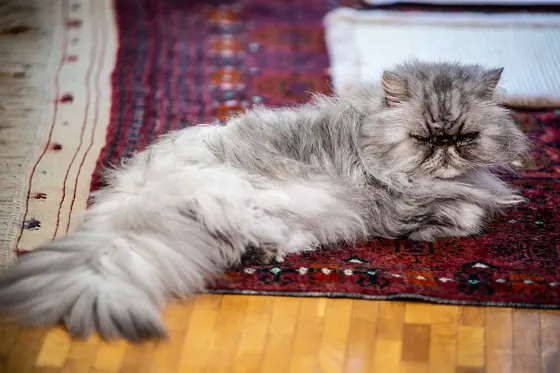
Brachycephaly means short-headed. In some breeds, above all the Persian, the Exotic Shorthair and the Himalayan, selection for an ever flatter face has shortened the bones of the face and nose, while the soft tissues, such as the palate, tear ducts and gums, still take up the same space. The result is a flatter face, with the nose set between the eyes, and a series of recurring problems. Within these breeds there is a lot of variation: cats of the traditional type, with some nose, have far fewer problems than extreme types with a completely flat face. Shape matters, a great deal.
Breathing
Narrow nostrils, sometimes almost closed, and a proportionally long soft palate make it hard for air to pass. Flat-faced cats may snore, breathe noisily, breathe with the mouth open after slight exertion or in the heat, and tolerate exercise, stress and high temperatures less well. They are at higher risk of heatstroke and of complications under anaesthetic. A cat breathing with the mouth open at rest is always an emergency, in a Persian too: it is not "normal for the breed". Where the nostrils are very narrow, surgery to open them greatly improves breathing.
Eyes
Their eyes are large, prominent and very exposed, and the eyelids sometimes do not close fully. The tear ducts are kinked by the shape of the skull, so tears do not drain properly into the nose and overflow, staining the face reddish brown: chronic tear staining is almost the norm. In addition, facial folds can rub against the eye and some have eyelids that turn inwards. They are at greater risk of corneal ulcers and corneal sequestrum, a brown or black spot on the cornea that usually needs surgery. An eye the cat squints or closes is a same-day visit.
Mouth and teeth
With a shortened jaw, the teeth end up crowded, rotated or misaligned, and the bite is often irregular. This encourages plaque build-up and periodontal disease, and some cats have trouble picking food up from the bowl. It helps to offer flat, wide plates, kibble shaped for their mouth or wet food, and to take great care with dental hygiene through brushing and frequent check-ups. If you see they struggle to eat, drop food or have bad breath, see the vet.
Skin and coat
Facial folds collect tears, food debris and moisture, and can become infected: they need cleaning daily with damp gauze and drying well afterwards. The Persian and Himalayan also have a long, very dense coat that tangles extremely easily and needs daily brushing; otherwise mats form that pull on the skin and end in a shave-down. Some find it hard to groom properly, especially the hindquarters, and need help to keep clean. And dermatophytosis, or ringworm, is more common in Persians. The Exotic Shorthair needs less brushing, but shares the facial problems.
Kidneys: polycystic kidney disease
Polycystic kidney disease (PKD) is an inherited disease in which cysts form in the kidneys, grow over the years and eventually cause kidney disease, usually in adulthood. For a long time it was very common in Persians and related breeds, such as the Exotic and Himalayan, and it also appears in the British Shorthair and others. There is a simple genetic test for the most common form, and responsible breeders have been testing their breeding cats for years, which has greatly reduced how often it occurs. If you buy a cat of these breeds, ask for the parents' negative test results. Kidney ultrasound also helps detect it.
Heart, births and other matters
Persians and some related breeds also have some predisposition to hypertrophic cardiomyopathy (HCM), which is detected with echocardiography. Very flat-faced queens have more difficult births, because the kittens' broad heads pass through with difficulty, and more caesareans. Anaesthesia needs extra precautions because of the airway. And because of their face, they find it harder to show some of the expressions cats use to communicate, which can complicate their relationships with other cats. None of this means a Persian or an Exotic cannot live a long, happy life, but it does mean they need extra attention.
How to choose a healthier cat
If you have fallen for a flat-faced cat, put health before an extreme look. Look for cats of a moderate type, with some nose and clearly open nostrils, eyes that do not bulge excessively and no heavy tear staining. Ask the breeder for the parents' PKD genetic test, echocardiograms of the breeding cats if they do them, and information about breathing or eye problems in the line. Be wary of anyone selling "the flatter the better". And consider adoption: there are adult Persians and Exotics in rescues, often because of coat care problems that can be solved with consistency.
Day-to-day care
Daily cleaning of eyes and facial folds with damp gauze, then drying. Daily brushing for long coats. Dental hygiene with animal toothpaste. A cool environment in summer, no exertion in the heat, and never in a car in the sun. A healthy weight: obesity makes breathing much worse. Check-ups at least once a year with attention to eyes, mouth, kidneys and heart. And learn to recognise the warning signs: open-mouth breathing, a closed or painful eye, not eating. Michipedia's breed profiles have more information on each one.
The flat face of Persians, Exotics and Himalayans brings breathing problems, chronic tear staining and ulcers, crowded teeth, folds that become infected and, in some lines, polycystic kidney disease. Choose cats of a moderate type with open nostrils and PKD-negative parents, and care for eyes, folds and coat every day.
Educational content from Michipedia, translated from the Spanish original. It does not replace the advice of a vet or a feline behaviour specialist. Every cat is an individual.