
Cats that don't shed: the honest answer
If you are after a cat that won't leave hair on the sofa, the short answer is that it doesn't exist, unless you choose a hairless one, which comes with demands of its own. The long answer is that some breeds shed far less, and a few habits cut the hair in your home dramatically.
All cats shed
A cat's coat grows, renews itself and falls out all the time, with peaks in spring and autumn as daylight hours and temperatures change. Cats that live indoors, with central heating and artificial light, often shed a little all year round rather than in two clear seasons. Cats also groom themselves constantly, and some of that hair ends up swallowed, which is where hairballs come from. How much a cat sheds depends mainly on its type of coat: cats with a double coat, a layer of long guard hairs over a dense undercoat, shed a lot; those with a single coat, short or curly, shed much less.
The hairless ones: the Sphynx and company
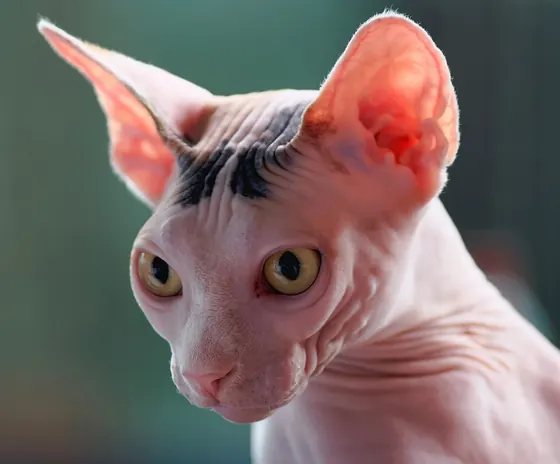
The Sphynx, the Donskoy and the Peterbald are the only cats that leave practically no hair around, because they have hardly any, although many have a fine, peach-like fuzz. But they are not low-maintenance cats. Their skin produces oil that no coat soaks up, so they need regular baths or wipe-downs, every one or two weeks, plus cleaning of the ears and skin folds. They feel the cold in winter and burn in the sun, so they need a warm home and no unsupervised sunbathing. And some are predisposed to hypertrophic cardiomyopathy. They are very affectionate, sociable cats, but you swap hair on the sofa for a different kind of care.
The Rex breeds: short, curly coats
The Devon Rex and the Cornish Rex have short, fine, curly coats without the layer of long guard hairs, which is why they shed very little. The Cornish has a soft, wavy coat; the Devon's is more uneven, with some almost bare patches. They are active, playful cats, very attached to their people, with a reputation for being a bit mischievous. The Selkirk Rex, on the other hand, has a curly but dense coat and sheds quite a lot more, while the curly-coated LaPerm sheds little. A word of warning: many Rex cats need their ears cleaned often, and their skin can get greasier than an ordinary cat's.
Short, close-lying coats: Siamese, Orientals and others
Cats with very short, fine coats that lie flat against the body, with hardly any undercoat, shed little and their hair is less noticeable. The Siamese, the Oriental Shorthair, the Burmese, the Tonkinese, the Bombay and the Singapura all belong to this group. The Bengal, with its short, dense, silky coat, also tends to shed little. The Balinese, despite its semi-long coat, has no undercoat and sheds less than its looks suggest. One thing, though: many of these breeds are very active and vocal, so choose them for their personality and not just their coat.
The heaviest shedders
So there are no surprises: long or semi-long haired cats with plenty of undercoat, such as the Persian, the Maine Coon, the Norwegian Forest Cat, the Siberian or the Ragdoll, shed an enormous amount, especially when they moult. So do some very dense shorthairs, like the British Shorthair, the Chartreux or the Exotic, whose plush coats leave quite a lot of hair behind. The ordinary domestic shorthair sheds moderately, with peaks during moults. With longhaired cats, on top of the hair around the house, you have to allow for daily or near-daily brushing to prevent mats.
Low-shedding is not the same as hypoallergenic
This is where the most common confusion lies. Cat allergy is not caused by hair but mainly by a protein called Fel d 1, produced in the saliva and in skin glands, which the cat spreads over its coat as it grooms. A cat that sheds little leaves less allergen-laden hair around the house, and that may help a little, but there is no cat that produces no allergens, not even the Sphynx. The Siberian and the Balinese are said to produce less Fel d 1, but it varies a great deal from one cat to another. If anyone at home has an allergy, choosing a cat has to start with an allergist and with spending time with that particular cat.
How to cut down hair at home
With any cat, three habits go a long way towards keeping hair under control. Brushing: once or twice a week for shorthairs, daily for longhairs, and more during moults, with a brush suited to the coat; every hair that comes out on the brush is one that doesn't end up on the sofa or in the cat's stomach. Good food, because a healthy coat sheds less and shines more. And cleaning: a vacuum cleaner with a filter, washable throws on its favourite spots and a lint roller to hand. If a cat suddenly starts losing much more hair than usual, or bald patches appear, that is not moulting: it needs to see a vet.
Moulting and the indoor cat
An indoor cat, with heating in winter and artificial light in the evenings, partly loses track of the seasons, and many shed more evenly through the year. It is not a health problem, but it does mean brushing can't be limited to spring and autumn. During the moulting peaks, which still happen, the cat also swallows more hair while grooming, and with it come more hairballs and the odd bout of vomiting. Brushing more in those weeks, offering cat grass if it tolerates it and, if your vet advises it, a food or a malt paste that helps pass hair, all make a big difference. If your cat often vomits hairballs, get it checked: it is not as normal as people think.
How to choose
If what worries you is hair on your clothes and furniture, a cat with a short, close-lying coat, a Rex or a well-brushed adult shorthair will make life easy. If what worries you is allergy, hair is a secondary issue and the allergist comes first. Either way, choose a cat for its personality and energy before its coat: a talkative Oriental or a tireless Devon Rex can be wonderful or a problem depending on your life. Each breed profile gives shedding and brushing needs so you can compare.
No cat is shed-free except the ones with no hair, and those need baths and protection from cold and sun. Rex cats and those with short, close-lying coats shed little; longhairs and plush-coated cats shed a lot. And shedding little is not the same as not causing allergies.
Educational content from Michipedia, translated from the Spanish original. It does not replace the advice of a vet or a feline behaviour specialist. Every cat is an individual.