
The bond with your cat and mental health: what we know and what we do not
Many people feel their cat helps them get through bad days, and it is not their imagination: the bond exists and it is mutual. But the science is more cautious than the headlines, and a cat is no substitute for professional help. This is what is known, without exaggeration.
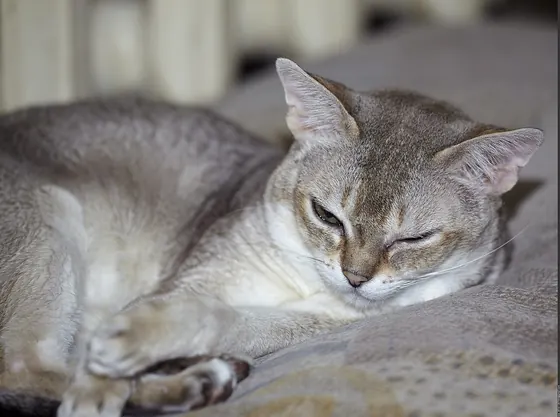
Cats really do bond
For years it was said that cats are independent and only care about whoever feeds them. Research over the last decade says otherwise. A 2019 study of kittens and adult cats, using the same test that is used with babies and dogs, found that most showed secure attachment to their person: they sought them out when they returned and relaxed in their presence. Other studies have shown that many cats recognise their own name among other words and can tell their owner’s voice apart. The bond with a cat is real, even if it is expressed differently from a dog’s: more subtle, more on its own terms and less noisy.
How your cat tells you it loves you
A cat does not wait for you wagging its tail, but it has its own language. It greets you with its tail up and the tip curved, rubs against your legs to leave its scent on you, follows you from room to room, sleeps near or on top of you, kneads on your lap and looks at you with half-closed eyes, blinking slowly. That slow blink is a sign of trust, and research has shown that if you return it, many cats come closer. Showing you its belly, on the other hand, is not always an invitation to stroke it. Understanding this language greatly improves the relationship.
What research says about wellbeing
Some studies link living with a cat to less loneliness, a more structured routine and daily moments of calm and contact, and many owners describe it that way in surveys. But the science is more cautious than the headlines suggest: other studies find no difference between people with and without cats, and some even find more anxiety among owners, perhaps because people who are struggling are more likely to seek an animal’s company. It is hard to separate cause from effect. The honest answer is that for many people a cat brings wellbeing, but it is not a treatment and it does not work the same way for everyone.
Purring and its myths
Purring is one of the most comforting sounds there is, and many people genuinely find it calming to have a purring cat on their lap. It has been widely claimed that its frequencies, roughly 25 to 150 hertz, heal bones, lower blood pressure or relieve pain. There are interesting hypotheses, but there is no solid evidence that purring has medical effects in people. What is clear is that calm contact with an animal you love is relaxing, and that is reason enough to value it. It is also worth knowing that cats purr when they are in pain or stressed, not only when they are content.
Routine, the most tangible benefit
One effect many people notice, especially in hard times, is routine. A cat needs to be fed on time, have its litter tray cleaned, be played with for a while and be brushed. Those small daily duties give structure to the day when getting up is hard, and the sense that someone depends on you can be an anchor. Unlike a dog, a cat does not make you go outside, which has a good side, because it adapts to any situation, and a less good one, because it does not nudge you to move or to see people.
When you are the one who is not well
If you are going through depression, an anxiety crisis or a very hard time, your cat can be a comfort, but it cannot be your only support. Talk to your GP or a mental health professional, and tell someone you trust. If you are having thoughts of harming yourself, in Spain you can call 024, the suicide prevention helpline, which is free and available around the clock, or 112 in an emergency. If you are elsewhere, contact your local emergency services or a crisis line in your country. Asking for help is not letting anyone down, your cat included: it is the best way to look after you both.
Caring for your cat when caring for yourself is hard
During bad patches, it is normal to struggle to keep on top of everything. Simplify: an automatic feeder, a water fountain, a large litter tray with clumping litter that only needs scooping once a day. Ask someone you trust to help with whatever you cannot manage. And make a plan in case you have to be away or go into hospital: who has keys, who can look after it, where its food, vaccination record and the vet’s number are. Knowing your cat will be looked after takes a great weight off when you need it most.
Emotional support animals in Spain
You often read about “emotional support animals”, a status recognised in some other countries, particularly the United States. In Spain there is no national regulation equivalent to that for assistance dogs, which are covered by regional laws that give them access to public places and transport. An emotional support cat therefore has no special legal status there to travel in the cabin free of charge or enter places where animals are not allowed. If a professional considers that your cat helps you, that has therapeutic value, but in Spain it does not give you special rights with an airline or a landlord.
The bond needs looking after too
A good relationship with a cat cannot be forced. Respect its pace: let it be the one to approach, stroke it where it likes, usually the head, cheeks and chin, and stop before it gets fed up. Play with it every day, because hunting play is one of the strongest forms of bonding. Give it high places, hiding spots and a predictable environment. And never punish it: a cat that is told off or frightened does not learn what you wanted, it only learns to distrust you. A cat that feels safe at home is a cat that comes to you.
Grief, which is real too
The other side of the bond is loss. Cats live many years, often fifteen or more, and keep us company through whole chapters of our lives. When they die, the grief can be as intense as for a person close to us, and sometimes the people around us do not understand. It is normal to feel sadness, guilt or an emptiness in the house. Give yourself time, talk about it with people who understand and do not rush to replace your cat if you are not ready. If the grief goes on for a long time or stops you functioning, seeking professional help makes sense too.
Cats form real attachment bonds with their people, and for many they bring company, calm and routine. But the science is cautious: a cat is not a treatment and does not replace professional help. If you are not well, ask for help; in Spain, the 024 helpline answers around the clock.
Educational content from Michipedia, translated from the Spanish original. It does not replace the advice of a vet or a feline behaviour specialist. Every cat is an individual.