
Why do cats always land on their feet? The righting reflex and its limits
Cats land on their feet thanks to the righting reflex: as soon as they sense they are falling, they turn their head and front half first, then their back half, and point their legs at the ground. But landing on their feet is not the same as landing safely: a fall from a balcony can still break their jaw, palate or legs.
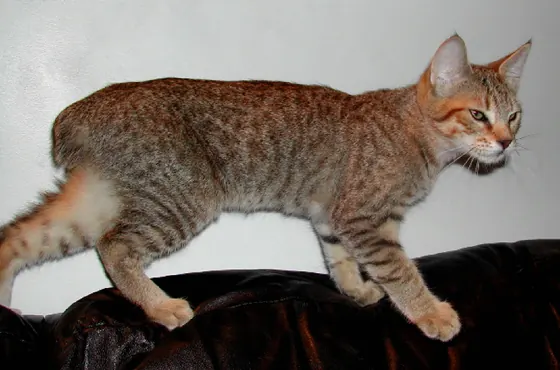
The righting reflex
When a cat loses its footing, its inner ear works out which way is down in a fraction of a second, and its eyes confirm it. From there an automatic reflex kicks in that it does not have to learn or think about: it turns its head to look down, then rotates the front of its body, then the back, and stretches its legs towards the ground with its back arched to cushion the impact. It all happens in under a second. This is called the righting reflex, and although other animals have similar versions, the cat’s is especially fast and precise thanks to its very flexible spine and the fact that its collarbone is not attached to the rest of the skeleton.
The physics puzzle that took years to solve
For years, the falling cat’s twist looked like a physics problem: how can a body falling with nothing to push against turn itself round? In 1894, the French physiologist Étienne-Jules Marey photographed a falling cat for the first time with a high-speed camera and showed that it really does. The explanation came later: the cat does not rotate as a single block, but bends at the waist and turns its two halves in opposite directions, tucking in and stretching out its legs to change how fast each half spins. That way it shares out the movement without breaking any law of physics. It is a fine example of an animal unknowingly solving a problem that took science decades to describe.
From what age it can do it
The reflex is not present at birth. It starts to appear at around three or four weeks of age, when the kitten is already walking and its inner ear is maturing, and it is refined until six or seven weeks, by which time the kitten performs it like an adult. That is why a very young kitten that falls off the sofa or out of someone’s arms can land on its side or its back and hurt itself. With newly arrived kittens, it is best always to pick them up while sitting down or close to the floor, and not to let children carry them around in their arms while standing.
Height matters, but not the way you think
To complete the turn, a cat needs a minimum amount of time in the air. From very low down, for example if it rolls off the bed sideways, it may not have time to turn fully. From greater heights it has plenty of time to orient itself, but the force of the impact increases with height. In 1987, a classic study by two New York vets, Whitney and Mehlhaff, reviewed 132 cats that had fallen from buildings and attracted attention because many of them survived, even from very high floors. That work is often quoted as proof that cats are almost indestructible, but it has an obvious bias: it only counted the cats that reached the clinic alive.
What about the tail? It helps, but it is not essential
It is often said that a cat uses its tail like a rudder to turn in mid-air. The tail helps with balance when the cat walks along a railing or turns sharply at a run, and it probably contributes a little during a fall, but the mid-air twist depends mainly on the flexibility of the spine and on how the cat moves the two halves of its body and its legs. The proof is that tailless or very short-tailed cats, such as the Manx or bobtails, also right themselves normally when they fall. What does affect the reflex is anything that disturbs the inner ear, such as a middle or inner ear infection, or old age and arthritis, which make a cat slower and stiffer. An older cat does not fall the way a two-year-old does.
Landing on its feet is not landing safely
Landing on all four feet reduces the damage, but it does not prevent it. The typical injuries from a fall from height even have their own name, high-rise syndrome: fractures of the jaw and palate, because the chin hits the ground after the legs, broken legs, chest trauma that makes breathing difficult and internal injuries that cannot be seen from the outside. A cat that seems fine after falling from a first or second floor may have internal bleeding or a pneumothorax. So any fall from a balcony or window, even if the cat gets up and walks away, means a trip to the vet that same day.
Why such agile animals fall
Cats do not fall because they are clumsy, but out of overconfidence and the hunting instinct. A passing pigeon, a fly or a sudden noise can make them leap or twist on a narrow railing, and in that moment they do not judge the drop. Cats also fall when they are dozing in the sun on a window ledge and wake with a start. In Spanish cities, falls are one of the most common emergencies in summer, when windows are left open for longer. The only reliable protection is physical: a strong mesh or net on balconies and windows, firmly anchored. Ordinary fly screens will not hold a cat’s weight.
What to do if your cat falls
If your cat has fallen from a height, pick it up carefully, supporting its body rather than holding it by the legs, wrapped in a towel if it is agitated, and put it in its carrier. Do not give it food or water in case it needs an anaesthetic. Phone the clinic on the way. Check whether it is breathing with its mouth open, bleeding from the nose or mouth, not putting weight on a leg or has pale gums: these are signs of a serious problem. Even if it seems unhurt, have it checked: many injuries only show up over the following hours. And if you cannot find it after a fall, search nearby courtyards, doorways and ground-floor premises straight away, because injured cats hide.
Cats land on their feet thanks to the righting reflex, which appears at around three or four weeks and is fully developed by six or seven: the inner ear senses where the ground is and the cat turns in two halves until its legs point downwards. But landing on its feet does not protect it from a broken jaw, broken legs or internal injuries. The real protection is mesh on balconies and windows.
Educational content from Michipedia, translated from the Spanish original. It does not replace the advice of a vet or a feline behaviour specialist. Every cat is an individual.