
My cat meows at night: why it happens and how to get your sleep back
A cat meowing at four in the morning has a reason, and it is almost always one of these: hunger, a need for activity, being in heat, having learnt that it works or, in older cats, a health problem. Knowing which one it is tells you what to do, and in a cat over ten, where to start.
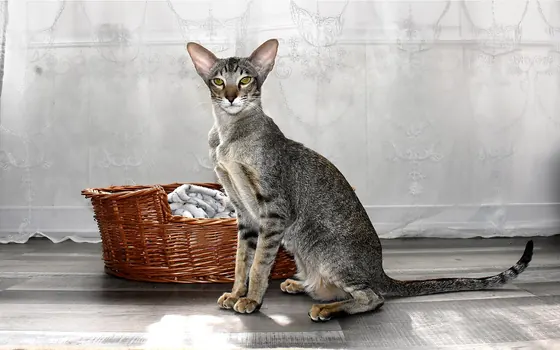
An older cat that starts meowing: vet first
If your cat is over ten and has recently started meowing at night, often with a loud, drawn-out, seemingly disoriented cry, the first stop is the vet, not training. Behind it there may be hyperthyroidism, very common in older cats and causing hunger, restlessness and vocalising; high blood pressure, often linked to kidney disease or to hyperthyroidism itself, which can affect eyesight; loss of sight or hearing, which disorients them in the dark; arthritis pain; or cognitive dysfunction syndrome, the feline equivalent of dementia. Almost all of these causes can be treated or managed, and the sooner they are picked up, the better. Ask for the cat's blood pressure to be taken.
Cats are not nocturnal, they are crepuscular
People often say cats are nocturnal, but they are actually crepuscular: their natural peak of activity is at dawn and dusk, when they hunt their prey in the wild. That is why so many cats go wild with energy at five in the morning. On top of that, an indoor cat that has spent the day asleep while you were at work reaches the evening rested and wanting to do something, just when you want to go to bed. It does not have a problem: its clock and yours simply do not match. The good news is that a cat's rhythm can be adjusted quite a lot by changing when it plays and when it eats.
The trick that works best: hunt, eat, sleep
A cat's natural cycle is hunt, eat, groom and sleep. You can use that. One or two hours before bed, have an intense play session of 10 to 15 minutes with a wand or a toy it can chase, pounce on and catch, until it pants a little or loses interest. Finish by letting it catch the toy. Straight afterwards, give it its last meal of the day, ideally some wet food. With the simulated hunt and a full stomach, it will normally groom and fall asleep. Many owners notice the change within a few days. What does not work is playing half-heartedly for five minutes, or feeding it at midday and expecting it to last until the next day without asking for anything.
The dawn hunger call
Many cats meow in the early hours because they are hungry and have learnt that you are the one who opens the tin. If one night you got up at five to feed it so it would be quiet, the cat learnt exactly that: meowing at five works. A programmable automatic feeder, which in Spain costs €35 to €100 depending on the model, breaks that link because the food arrives without you, at the time you choose. Splitting the daily ration into several small meals, which is also the closest thing to how cats eat naturally, helps too. And if it suddenly has an appetite it did not have before, remember that this can also be hyperthyroidism or diabetes.
If she is not spayed: heat
A female cat in heat meows in an unmistakable way: loudly, insistently and at any hour, rolling around, raising her hindquarters and trying to get out. Many first-time owners think she is in pain. Female cats can come into heat every few weeks for much of the year, especially when days are long, and if they are not mated it keeps coming back. Unneutered males, for their part, meow and try to get out when they smell a female in heat, even several floors away, and they also tend to spray urine. Neutering almost completely solves this meowing, and it is also what vets recommend for the cat's health and what animal welfare rules require for most pet cats in Spain; elsewhere, check the rules where you live.
When it has learnt that it works
A cat that meows and gets something, whether food, a door opened, you getting up or simply you talking to it, learns to meow more. Even telling it off is a form of attention to a bored cat. The only way to break the habit is for it to stop working: do not respond to night-time attention-seeking meows in any way, and instead give plenty of attention and play during the day and before bed. A word of warning: it usually gets worse at first, because the cat tries harder before giving up, and if you give in at that point you teach it to meow even louder. It is important to have ruled out real hunger or a medical cause first, so you are not ignoring a genuine need.
Let it into the bedroom or not?
Many cats meow outside a closed bedroom door because to them a closed door is a piece of their territory being denied to them, and they want to be where you are. There is no single answer. Some cats, if allowed to sleep with you, curl up and give no trouble all night, and for many households that is the simplest solution. Others, once inside, wake you by walking on you or chasing your feet. If you prefer to keep the door shut, be consistent from the start and offer an inviting bed outside, high up and warm, near the door. What does not work is closing it some nights and not others, because that teaches the cat that persistence sometimes pays off.
Boredom and indoor cats
An indoor cat with nothing to do all day is a prime candidate for night-time meowing. Beyond play before bed, there are things that help during the day: a spot by a window to look outside, scratching posts and high shelves, toys rotated every few days so they stay novel, puzzle feeders that make it work for part of its food, and cardboard boxes to explore. If you are out of the house for long hours, someone coming round to play for a while or, in some cases and with a careful introduction, a compatible second cat can help. A cat that has had an interesting day sleeps better at night.
When the meow is pain or distress
Some meows are not attention-seeking. A cat that meows strangely while trying to pee or poo, that vocalises when moving, jumping or when you touch a certain area, that hides and meows, or that meows and has also stopped eating, is telling you something is wrong. In these cases, ignoring it is a mistake. The same goes for meowing that appears suddenly in a cat that never used to meow at night, at any age. And if it is a male going in and out of the tray without managing to pee, it is an emergency. The general rule: when a cat's behaviour changes abruptly, the first suspicion should always be medical.
If an older cat has started meowing at night, see the vet first: hyperthyroidism, high blood pressure, loss of sight or hearing, pain or cognitive decline. Otherwise: intense play before bed followed by its last meal, an automatic feeder for dawn hunger, neutering if it is entire, and never respond to attention-seeking meows.
Educational content from Michipedia, translated from the Spanish original. It does not replace the advice of a vet or a feline behaviour specialist. Every cat is an individual.