
Heatstroke in cats: how to recognise it and what to do
Cats tolerate heat better than dogs and seek out the coolest spot in the house on their own. That is why feline heatstroke almost always happens when they cannot choose: shut in a room, in a car, in a carrier in the sun. And a cat panting in summer is a sign you cannot ignore.
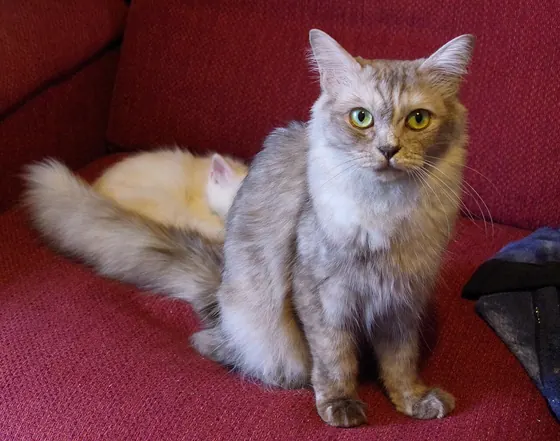
How a cat cools down
Cats sweat very little, only through their paw pads, and their main way of losing heat is to seek shade, stretch out on cool surfaces such as floor tiles, reduce activity and groom: the saliva spread over the fur evaporates and cools them. Panting, on the other hand, is something a cat does very little, only after intense effort or a fright, and only briefly. So in a cat, panting with the mouth open at rest is always a warning sign: either they are overheated or they have a breathing or heart problem. If you see it, do not simply put it down to the heat.
Where it happens
In most cases the cat has been unable to escape the heat. Closed, south-facing rooms, attics, glazed sun rooms and enclosed terraces without shade in high summer. Parked cars, even briefly: with 25 °C (77 °F) outside, the inside goes above 40 °C (104 °F) in under twenty minutes. Carriers left in the sun during a journey or while waiting at the clinic. Tumble dryers and washing machines, which some cats climb into to sleep. And homes where the power or air conditioning has gone off during a heatwave. It can also happen after intense exertion on a very hot day, in cats with outdoor access.
Which cats are most at risk
Flat-faced breeds such as the Persian, Exotic and Himalayan, because their airways work less well and they cool down poorly. Overweight cats. Cats with heart disease, such as hypertrophic cardiomyopathy (HCM), or respiratory disease, such as asthma. Kittens and older cats, which regulate temperature less well and drink less. Cats with very long, dense coats if they are not brushed, because matted fur stops air circulating. And those with kidney disease, which dehydrate easily. If your cat is in any of these groups, they need extra watching in summer.
The signs, in order
First, restlessness, seeking cool places, a lot of grooming and faster breathing. Then open-mouth panting, drooling, bright red gums and tongue, a rapid pulse. If it continues, staggering, weakness, vomiting or diarrhoea, disorientation and, in the severe phase, collapse, seizures or loss of consciousness. A cat's normal temperature is around 38 to 39.2 °C (100.4 to 102.6 °F); above 40 °C (104 °F) you need to act, and above 41 °C (105.8 °F) it is a serious emergency. As with dogs, a cat that has suffered severe heatstroke may seem to recover and then deteriorate a day or two later because of kidney, liver or clotting damage.
First aid: the first ten minutes
Get them out of the heat immediately and into a cool or air-conditioned room. Wet their fur with cool tap water, not ice-cold, especially on the belly, groin, armpits, neck and paw pads; a damp cloth that you keep refreshing works well with cats that will not tolerate water. Put a fan nearby so the water evaporates, which is what cools them. Offer water to drink if they are conscious, without forcing it. Call the vet while you do this and head for the clinic with the carrier open or well ventilated and the car air conditioning on. If you have a thermometer, stop active cooling when the temperature drops below 39.5 °C (103.1 °F) so as not to cause the opposite problem.
What not to do
Do not plunge them into iced water or put ice directly on them: intense cold constricts the blood vessels in the skin through which heat has to escape and can cause shivering, which generates more heat. Do not wrap them in a wet towel and leave them like that: within minutes the towel warms up and acts like a blanket. Do not give any medicine, least of all human fever reducers: paracetamol is deadly to cats and ibuprofen damages their kidneys and stomach. And do not stay at home waiting to see if they improve: intravenous fluids and organ monitoring are done at the clinic.
What the vet will do and what it costs
Controlled cooling, oxygen if they are struggling to breathe, intravenous fluids and blood tests to assess the kidneys, liver, glucose and clotting, repeated over the following hours. A cat with severe heatstroke is usually hospitalised for one to three days. As a guide in Spain in 2026, the emergency visit with initial stabilisation can come to around 150 to 400 €, and hospitalisation with repeated blood tests 400 to 1,200 € or more depending on severity and clinic. Mild cases caught early are resolved for much less.
Your home in summer
Always give the cat access to several rooms, including the coolest ones, with doors open or wedged so a draught cannot close them. Lower the blinds during the sunniest hours. Fresh water in several places, changed daily; many cats drink more from a fountain or wide bowls. Wet food helps them stay hydrated. A floor tile, a cooling mat or a damp towel on the floor gives them somewhere to lie. If you go on holiday or spend the day out during a heatwave, leave the air conditioning on a timer or ask someone to check on the cat. And check the washing machine and dryer before switching them on.
Balconies, journeys and carriers
A sunny balcony in July is no place to leave a cat without shade and water, and in summer, with windows open, falls also increase sharply: safety netting solves both problems. When travelling, choose cool times of day, never leave the cat alone in the car, not even for a moment, and do not put the carrier in the sun or in the boot. While waiting at the clinic or the station, find shade. And in longhaired cats, frequent brushing removes the dead undercoat and helps air circulate; shaving a cat because of the heat is not usually necessary and removes their protection from the sun.
A cat panting with the mouth open in summer is in trouble. Cool them with cool water and moving air, never with ice, and go to the vet even if they seem to be getting better. Prevention is simple: always let them choose a cool spot, plenty of water and never, not for a minute, a closed car.
Educational content from Michipedia, translated from the Spanish original. It does not replace the advice of a vet or a feline behaviour specialist. Every cat is an individual.