
Why do cats miaow at people? A language invented just for us
Cats miaow at people because, above all, it is a way of communicating with us. Kittens miaow to their mother, but adult cats barely miaow to each other: they communicate through scent, body posture and other sounds. They keep miaowing at people because it works: we understand that they want something and we respond.
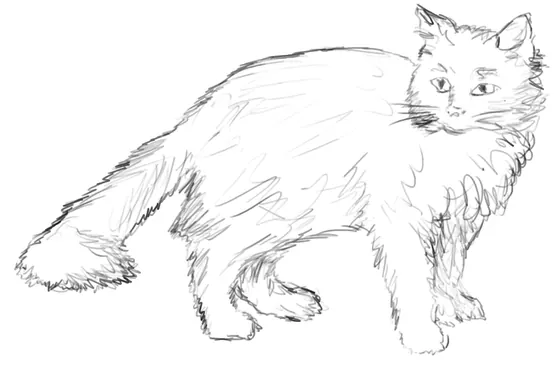
Between cats, there is hardly any miaowing
If you watch a colony of cats or a home with several cats, you will notice something curious: the adults hardly ever miaow to each other. They communicate through scent marking, rubbing, the position of the tail, ears and body, and other sounds such as purring, growling, hissing and trilling. Between cats, miaowing mainly appears in specific situations: kittens calling their mother when they are hungry, cold or lost, and adults during heat, with those long, loud calls everyone recognises. Beyond that, miaowing between adult cats is rare.
A kitten sound they keep for us
The most widely accepted explanation is that miaowing directed at people is an extension of the communication between kitten and mother. Kittens miaow to ask for attention, food or help, and domestic cats living with humans keep that tool into adulthood because they discover that it works. We respond to miaows: we get up, open the door, put the food down. Over time, each cat learns which miaows get results with its people and uses them more and more. In a way, it is a language built up in each home between a cat and its humans.
Every cat has its own repertoire
There is no universal dictionary of miaows. Studies on the acoustics of miaowing show that miaows vary a great deal in length, pitch and intonation depending on the cat and the situation, and that people who live with a cat learn to tell its miaows apart better than those of unfamiliar cats. In other words, you and your cat have developed your own code. Even so, there are general patterns: short, high-pitched miaows tend to be greetings or gentle requests; longer, insistent ones, more urgent demands; low, drawn-out ones, complaints or discomfort. Some breeds, such as the Siamese and the Oriental, are famous for being far chattier than average.
The purr that asks for food
There is one particularly effective sound many cats use to ask for things: the solicitation purr. In 2009, a team at the University of Sussex led by Karen McComb published a study in the journal Current Biology analysing the purrs of cats that woke their owners to ask for food. They found that this purr carries an embedded high-pitched component, similar to a cry, which people perceive as more urgent and less pleasant than a normal purr, even if they don’t own cats. The authors suggested that the cat is exploiting our sensitivity to the sounds of infants. It is a very effective way of getting breakfast at six in the morning.
What your cat is asking for
Most miaows aimed at people are requests or greetings. Your cat may miaow to greet you when you come home, to ask for food, to get you to open a door or window, to play, to be stroked or simply to get your attention. Cats also miaow to complain, for example when they are in the carrier or are picked up against their will. Look at the context: where your cat is, which way it is looking, what time it is and what happened the last time it miaowed like that. The request is nearly always obvious. And answering, even just by talking back, is part of your relationship.
When your cat miaows too much
If your cat miaows a lot and always gets what it wants, you have most likely fallen into a loop: it miaows, you respond, and it learns that miaowing works. To reduce it, the key is not to reward insistent miaowing, for example by not feeding it the moment it miaows at odd hours, and instead to give it what it needs in a predictable way: meals at set times, automatic feeders, play sessions before bed. Ignoring it may at first make it miaow more for a few days before things improve. Never punish it: cats don’t understand punishment and it only increases their stress. And make sure its needs for play and stimulation are met.
When miaowing is a warning sign
A sudden change in the way your cat miaows deserves attention. A cat that suddenly miaows much more, especially at night, may be in pain, excessively hungry because of hyperthyroidism, suffering from high blood pressure or, in older cats, experiencing cognitive decline, which causes disorientation and night-time miaowing. Cats that go deaf tend to miaow more loudly. A hoarse miaow or loss of voice can point to a respiratory infection or a problem with the larynx. And a cat that miaows or cries when weeing, or goes to the litter tray many times without producing anything, may have a urinary blockage, which in males is an emergency. In any of these situations, see the vet.
Females in heat and other special miaows
Some miaows are not aimed at people even though we hear them. A female cat in heat miaows intensely, at length and almost constantly for days, often rolling on the floor and raising her hindquarters; it is a call to males, and it comes back every few weeks in spring and summer if she is not spayed. Unneutered males also miaow and spray more. Neutering, which in Spain Law 7/2023 requires before six months of age for cats not registered as breeding animals, gets rid of these calls. Then there are the complaining miaows in the carrier or the car: part of travelling that improves if you get your cat used to it gradually.
Adult cats hardly ever miaow to each other: miaowing is a kitten behaviour they keep for communicating with people because it works. Each cat builds its own repertoire with its humans, and some use a solicitation purr with a cry-like tone we find hard to ignore. A sudden change in how a cat miaows, especially an older cat, is worth a trip to the vet.
Educational content from Michipedia, translated from the Spanish original. It does not replace the advice of a vet or a feline behaviour specialist. Every cat is an individual.