
Black cats: why they wait longer, and why they should not
Many rescues say the same thing: black cats wait longer. Because of superstition, because of photos that do not do them justice, or simply because there are so many of them. But a black cat is every bit as affectionate, healthy and fun as any other. And it has a few advantages of its own.
A bad reputation centuries old
The link between black cats and bad luck goes back to medieval Europe, when they became associated with witchcraft and cats were persecuted, sometimes alongside the women who looked after them. That is where the superstition that crossing paths with a black cat brings misfortune comes from, and it is still repeated half in jest. But it is not universal: in other cultures the black cat is a symbol of good luck. In the UK or Japan, for example, it is associated with good fortune, and in ancient Egypt cats in general were revered. The superstition says a lot about European history and nothing at all about black cats.
Are they really adopted less?
It is a very widespread impression in rescues, and the odd study has found that black cats take longer to be adopted, or that people rate them less favourably in surveys. Other studies find no such clear differences, and bear in mind that black is one of the most common colours in cats, so in absolute numbers they are also among the most adopted. What does seem clear is that when there are lots of cats to choose from, an adult black cat has a harder time standing out. And rescues know it well: there are many of them, and they wait.
The photo problem
These days nearly every adoption starts with a photo online, and that is where black cats lose out. Photographing a black cat is hard: phones struggle to pick up detail, the face comes out as a dark blob in which only the eyes show, and you can see neither its expression nor the shine of its coat. Many rescues now take special photos of them in good natural light against pale backgrounds. If you are looking for a cat, do not go on the photo alone: ask about its personality and, if you can, go and meet it. In person, a black cat shines, quite literally.
What a black cat is
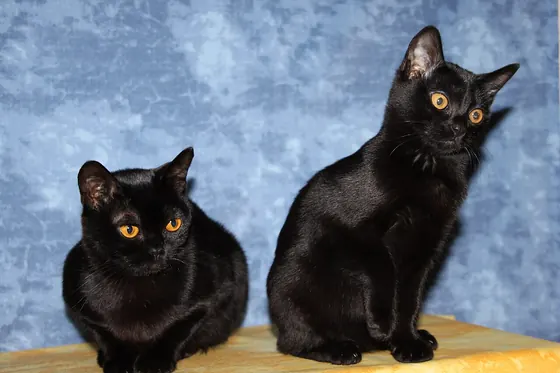
Black is not a breed but a colour that turns up in a huge number of breeds and, above all, in the ordinary moggy. Genetically, it depends mainly on a gene that suppresses the tabby pattern, although many black cats show very faint ghost stripes in sunlight, especially as kittens. Some black cats turn reddish or brown over time or with a lot of sun, and in old age they can go grey. There is one breed, the Bombay, bred specifically to look like a little black panther with copper eyes, and black cats also exist among British Shorthairs, Persians, Orientals and Maine Coons.
Personality: like any other cat
There is no basis for thinking a black cat has a different personality because of its colour. There has been speculation about a link between coat colour and personality in cats, and some surveys show that owners attribute traits according to colour, but what shapes a cat's personality most is its individuality, its genes in general, how it was socialised as a kitten and what it has been through. Black cats, like all the others, can be cuddly, independent, playful or calm. Anyone who has had one tends to say it was the most affectionate cat they have ever known, but owners of tabbies say that too.
Extra caution at certain times of year
In some countries, rescues take extra precautions with black cats around dates such as Halloween, for fear that someone might want them as decoration or for something worse, and some suspend their adoptions for a while. The practice is debated, because it also takes chances away from them. Either way, it is one more reason why good rescues carry out interviews and follow-ups: they are looking for a family, not a buyer. If you get questions like these when adopting a black cat, it is not mistrust of you: it is them doing their job well.
The advantages of a black cat
As well as being just as good as any other cat, they have some practical advantages. Their coat, glossy and silky when healthy, is one of the most beautiful there is, and a well cared for black cat looks like a small panther. Their eyes, yellow, green or copper, really stand out. Their hair does not show on dark clothes. And because rescues have so many of them, you have plenty of choice to find the personality that suits you best, which is what really matters. Adopting an adult black cat also means giving a chance to one of the cats that waits longest.
A few care points for a black coat
A black cat needs no special care because of its colour, but there are a couple of details worth knowing. The coat can lighten in the sun and turn reddish or brown, which does not matter in a healthy cat, although a sudden change of colour or a dull, brittle coat can be a sign of a diet or health problem and is worth mentioning to the vet. On dark skin it is harder to spot fleas, wounds or small lumps, so part the fur with your fingers to check when you brush it. And in an older cat, grey hairs on the muzzle or back are normal, as in any other cat.
If you are tempted
Ask your local rescue about their black cats, especially the adults. Ask them to tell you what each one is like: whether it is cuddly, whether it gets on with other cats or with dogs, whether it is calm or active. Go and meet them in person. And once it is home, take photos in natural light, by a window, without flash, and you will see how photogenic it really is. Many rescues run black cat adoption campaigns, sometimes with reduced fees, so ask. And show it off: every happy black cat in a photo helps the next one wait a little less.
The black cat's bad reputation is a European superstition that says nothing about the cats themselves. They wait longer in rescues because there are so many of them, they photograph badly and some still carry the myth. But their personality and health are like any other cat's, and adopting one gives a chance to the cat that waits longest.
Educational content from Michipedia, translated from the Spanish original. It does not replace the advice of a vet or a feline behaviour specialist. Every cat is an individual.