
Maine Coon or Ragdoll: how they are alike, how they differ and which suits you
They are two of the most sought-after breeds in Spain and are often compared: both are large, sociable, semi-longhaired cats with a reputation as “dogs in a cat’s body”. But they have clear differences in temperament, activity and care that may decide which one suits you better.
Two gentle giants, not twins
The Maine Coon and the Ragdoll share a large size, a semi-long coat and a very sociable nature, so it is natural for anyone looking for a big, affectionate cat to hesitate between them. But their origins, looks and personalities are quite different. The Maine Coon is a cat of rustic origin, robust, active and curious. The Ragdoll is a companion breed created in the twentieth century, calmer and more attached to its people. Neither is better than the other: what changes is the kind of home and person each one suits.
Where each comes from
The Maine Coon is one of the oldest cats in North America. It developed naturally in the state of Maine, in the north-east of the United States, as a farm and ship’s cat adapted to very harsh winters; hence its water-resistant coat, its large paws with tufts between the toes and its long, bushy tail that it wraps around itself. The Ragdoll, on the other hand, was created in California in the 1960s, from a white semi-longhaired female and several males, with the aim of producing a large cat with a very docile temperament. One is the product of climate and work; the other, of selection for companionship.
Appearance
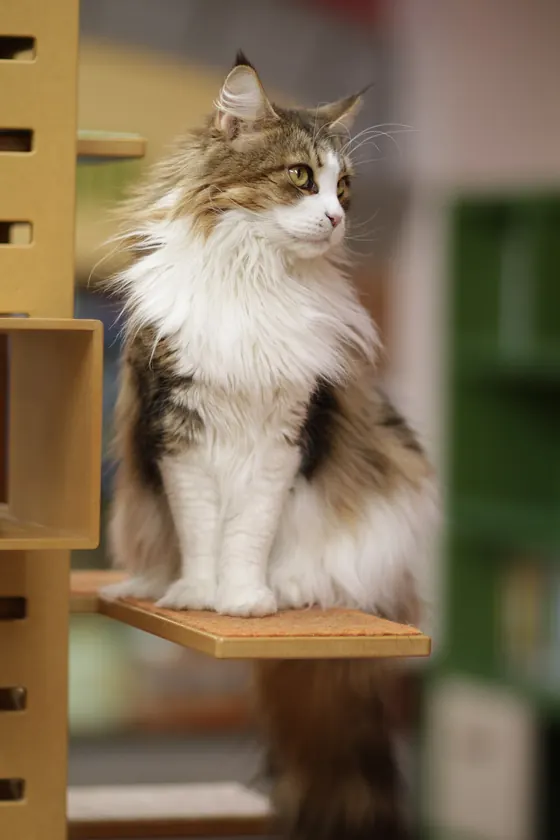
The Maine Coon has a long, muscular, rectangular body, a large head with a square muzzle, big, tall ears often with lynx-like tufts at the tips, and a wide range of colours: brown tabby, black, white, silver, bicolour and many more. The Ragdoll has a large, slightly softer body, a broad head, medium ears and always blue eyes, with a pointed pattern, meaning a pale body with a darker face, ears, legs and tail, in its colourpoint, mitted (with white mittens) and bicolour varieties. They are easy to tell apart at a glance.
Size
Both are among the largest cats, and both mature slowly: they do not reach their final size until three or four years old, sometimes later in the Maine Coon. An adult Maine Coon usually weighs between 5.5 and 9 kg (12 to 20 lb), and some males exceed that; it is also long and tall. The Ragdoll weighs between 4.5 and 9 kg (10 to 20 lb), with males clearly larger than females. In practice, both need a large litter tray, a sturdy scratching post that does not wobble under their weight and a carrier almost the size of one for a medium dog. And for flights, many males of both breeds exceed the weight allowed in the cabin.
Temperament: what they share
Both are sociable, affectionate and rarely aggressive cats, which usually get on well with children, dogs and other cats, and become very attached to their family. Neither is an aloof cat that goes its own way: both follow their people around the house and want to be involved in whatever is going on. Nor are they very vocal cats; the Maine Coon has a curious repertoire of trills and chirps rather than meows, and the Ragdoll usually has a soft voice. For a family that wants a present, affectionate cat, both are good choices.
Temperament: the nuances that set them apart
Here lies the big difference. The Maine Coon is more active, curious and playful, even as an adult: it likes to climb, explore, hunt toys, open cupboards and, in many cases, play with water. It is independent in its own way, affectionate but not always a lap cat. The Ragdoll is calmer, more sedentary and far more of an arms-and-sofa cat; it is famous because many go completely limp when picked up, though not all, and that docility is part of its charm. If you are looking for a playmate, the Maine Coon; if you want a cat to curl up beside you in the evening, the Ragdoll.
Activity and indoor life
Both adapt well to indoor life, but with different needs. The Maine Coon needs more stimulation: tall, solid scratching posts, daily hunting play, puzzle toys and, if possible, a protected balcony or a catio. A bored Maine Coon in a small flat can become mischievous. The Ragdoll needs less activity and is content with gentler play sessions, although that makes it more prone to putting on weight. One important point about the Ragdoll: it is very trusting and not very streetwise about danger, and does not always land well when it jumps, so it is not a cat to let roam outdoors.
Coat and brushing
Both have semi-long coats, but with a different texture. The Maine Coon’s is dense, with an abundant undercoat and a coarser, water-resistant outer coat, a ruff at the neck and “breeches” on the thighs; it sheds quite a lot and can develop knots on the belly and behind the legs if not brushed. The Ragdoll’s is silky, with little undercoat, and tangles less than you might expect, although the armpits and behind the ears still need watching. As a guide, two or three brushes a week for both, more during the spring moult. Neither is hypoallergenic.
Health: what to ask the breeder
Both breeds have a known predisposition to hypertrophic cardiomyopathy, the most common heart disease in cats, and each has its own mutation of the MYBPC3 gene, with a genetic test available. A responsible breeder should test breeding cats genetically and also carry out regular echocardiograms, because the test does not detect every form. In the Maine Coon, breeders also screen for spinal muscular atrophy, with a genetic test, and hip dysplasia, which is more common than you would expect in a cat. In the Ragdoll, kidney and urinary problems are also monitored. Their life expectancy is similar, around 12 to 15 years.
Price and where to buy
A pedigree kitten of either breed, from a registered breeder who health-tests the parents, costs between about €900 and €2,000 in Spain, depending on the lines and quality. Because of their popularity, there are countless adverts for so-called Maine Coons and Ragdolls at bargain prices, with no pedigree or tests, often from breeders that do not comply with the law, or outright scams. Be wary of bargains, of sellers who will not let you see the mother and of those who ship kittens without meeting you. And remember that rescues also have cats of these breeds and crosses.
For flats, children and first-time owners
Both are good cats for families with children, as long as the children are taught to treat them with respect, and for first-time owners willing to brush regularly. For a flat, the Ragdoll adapts slightly better to small spaces thanks to its calm nature, while the Maine Coon appreciates more vertical space and stimulation. Both cope reasonably well with being alone during a working day, although neither is ideal for spending whole days alone. And because of their size, both need bigger, tougher accessories than an average cat.
So which should I choose?
Lean towards the Maine Coon if you want an active, curious, playful cat that keeps you company in everything but at its own pace, and if you can offer it space, large scratching posts and daily play. Lean towards the Ragdoll if you prefer a calm cat that loves being held and lounging on the sofa, adapts well to a flat and stays close by your side. In either case, choose a breeder who does the heart tests, or consider adoption. And remember that breed gives tendencies, not guarantees: every cat is an individual, and its personality depends a great deal on how it was raised and how it lives.
The Maine Coon and the Ragdoll are both large, sociable and semi-longhaired. The Maine Coon is more active, curious and playful, and needs more space and stimulation; the Ragdoll is calmer, a lap and sofa cat. Both are at risk of hypertrophic cardiomyopathy: insist on health tests from the breeder.
Educational content from Michipedia, translated from the Spanish original. It does not replace the advice of a vet or a feline behaviour specialist. Every cat is an individual.