
Why do cats wag their tails? A quick guide to reading a cat’s tail
In cats, a tail swishing from side to side is rarely happiness, as it is in dogs: it usually signals arousal, focus or irritation, and if the lashing is strong, the cat wants to be left alone. A tail held straight up, on the other hand, is a friendly greeting.
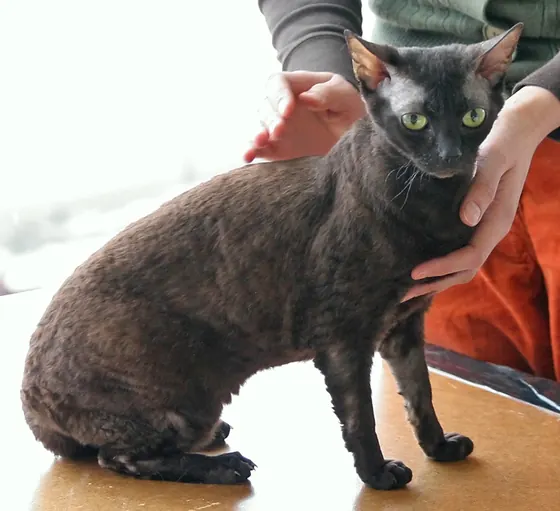
A cat is not a dog
The most common mistake when reading a cat’s tail is to read it like a dog’s. In dogs, a wagging tail tends to go with happiness or social excitement. In cats, a wide side-to-side swish almost always means something is winding them up or bothering them. Plenty of people end up scratched because they kept stroking a cat that had been thrashing its tail for a while. The tail is one of a cat’s main ways of communicating, and learning to read it, together with the ears, eyes and body posture, prevents a lot of misunderstandings. It also explains much of the friction between dogs and cats that live together: the dog takes the cat’s swishing tail as an invitation to play, and the cat reads the dog’s raised tail as something other than what it is. With patience and well-managed introductions, most of them end up understanding each other.
Tail up: a greeting
A cat that comes towards you with its tail raised straight up, sometimes with the tip curled slightly into a hook or a question mark, is greeting you in a friendly way. It is the clearest sign of goodwill a cat has. Observational studies of cat colonies, such as the one by Simona Cafazzo and Eugenia Natoli published in 2009 in the journal Behavioural Processes, describe the raised tail as a signal of friendly intent between cats, often followed by head and body rubbing. Cats use it with people in exactly the same way. If the raised tail also quivers a little, that usually means a lot of positive excitement, for example when you get home or when it spots its food.
Lashing from side to side: watch out
When the tail swings hard from side to side like a whip, or thumps the floor or the sofa, the cat is irritated, overstimulated or tense. It is typical during stroking: at first the tail is still and the cat purrs, then the tip starts to twitch, then the whole tail moves, and if you do not stop, a bite or a swipe follows. It is the cat’s way of warning you first. Faced with a tail like that, the best thing is to take your hand away and give it some space. You will also see it when a cat spots another cat through the window or during a stand-off: it is a sign that tension is building.
A twitching tip: attention
If only the tip of the tail moves, with small flicks or twitches while the rest of the body stays still, the cat is alert and focused on something. It might be a toy, a noise or prey. It is also the tail of a cat crouching in ambush before it pounces, often with that wiggle of the back legs just before the attack. When the cat is lying down and relaxed, a tail tip that moves gently while you talk to it may simply mean it is listening to you without bothering to turn round. Context explains almost everything.
Puffed up, held low or tucked between the legs
A bushy tail, with the fur standing on end and twice its normal thickness, is a frightened or defensive tail: the cat is trying to look bigger in the face of a threat. It usually comes with an arched back, the body turned sideways and hissing, or it appears suddenly after a fright. Leave the cat alone and do not try to pick it up. A tail held low, pressed against the body or tucked between the back legs signals fear, insecurity or submission. And a tail wrapped around the body while the cat sits or lies down is usually a calm, self-contained posture, although cats also do it when they are cold.
The tail as a balancing aid
As well as communicating, the tail has a physical job: it helps the cat keep its balance. When it walks along the narrow edge of a shelf or a fence, it moves its tail to one side or the other to counterbalance its weight, like a tightrope walker with a pole. It also uses it when running and making sharp turns, to change direction without losing stability, and when jumping. That is why cats that have lost their tail in an accident often take a while to get their agility back, although most adapt very well. And it is why you should never pull a cat’s tail, not even as a joke: as well as hurting, it can damage the nerves that control the bladder and bowel, which run through that part of the spine.
The tail when sleeping or lying down
A cat lying down and swishing its tail while you stroke it is not always content, even if it is purring: purring does not always mean pleasure, and the tail may be saying that enough is enough. On the other hand, a sleeping cat giving little flicks of its tail may simply be in REM sleep, the dreaming phase, when small movements of the whiskers, paws and tail are normal. To know how a cat feels you have to look at the whole animal: ears forward or turned sideways, eyes half closed or pupils dilated, body relaxed or tense. The tail alone is not enough.
Tailless cats and tails that stop moving
Some cats have a very short tail or no tail at all because of their genetics, such as the Manx or the bobtail breeds, and they communicate just as well with the rest of the body, even if other cats find them a little harder to read. What should catch your attention is a cat that suddenly carries its tail limp and does not move it, will not let you touch it or has trouble passing urine or faeces. It could be an injury, for example a fracture or a pulled tail after being caught in a door or hit by a car, which sometimes damages the nerves in that area. Pain at the base of the tail from fleas or a bite abscess can show up the same way. In any of these cases, see the vet.
In cats, a raised tail is a friendly greeting; side-to-side lashing means irritation or overstimulation, and it is time to stop; a twitching tip means attention; a puffed-up tail means fright and a low tail, fear. Do not read it like a dog’s, and always look at the whole cat.
Educational content from Michipedia, translated from the Spanish original. It does not replace the advice of a vet or a feline behaviour specialist. Every cat is an individual.