
Bambino
Also known as: Bambino cat · Dwarf Sphynx · Bambino Sphynx · XL Bully Cat
Photos: Heikki Siltala (CC BY-SA 3.0), via Wikimedia Commons.
Breed profile
* An estimate for Spain in 2026 (food, litter, vet and insurance), based on the size, grooming and health needs of the breed, not on measured costs of individual cats.
What it is like
It was born in 2005 at the Holy Moly cattery in Arkansas, in the United States, where Stephanie and Pat Osborne crossed a Munchkin with a Sphynx to combine in one cat the short legs of the first and the hairlessness of the second. Its name means “little child” in Italian. It needs saying plainly: it is a controversial cat. It combines two mutations that already have consequences on their own, dwarfism and hairlessness, and none of the large registries (CFA, FIFe, GCCF, WCF) gives it show breed status; TICA only accepts it as an experimental breed, and it is registered by the REFR, a rare breeds association. In 2019 the Dutch food and consumer product safety authority ordered a couple to stop breeding them on animal welfare grounds, and many vets consider breeding cats like this unethical. In character it is affectionate, playful and very attached to its people, like the Sphynx.
Temperament
Care
It needs the care of a hairless cat: a warm home, heated beds and clothing when it is cold; baths or wipes every one or two weeks to remove skin oil, frequent ear cleaning and protection from the sun. Because of its short legs, give it ramps or steps to reach high places, a low-sided litter tray, and stop it jumping down from great heights. Keeping its weight in check is key for its joints.
Health
It inherits the problems of both mutations. From the Munchkin, the chondrodysplasia that shortens the legs, with a higher risk of arthritis, lordosis (sunken spine) and pectus excavatum (sunken chest). From the Sphynx, hypertrophic cardiomyopathy (ask for the parents' echocardiograms), skin problems and sensitivity to cold and sun. If you are considering one, bear in mind that you are supporting a type of breeding many vets advise against; a Sphynx or an adopted cat are alternatives without that burden.
Fun facts
Its name means “little child” in Italian.
In 2019 the Dutch food and consumer product safety authority ordered a couple to stop breeding them for animal welfare reasons.
It has even been called the “XL Bully Cat”, in comparison with the American Bully dog.
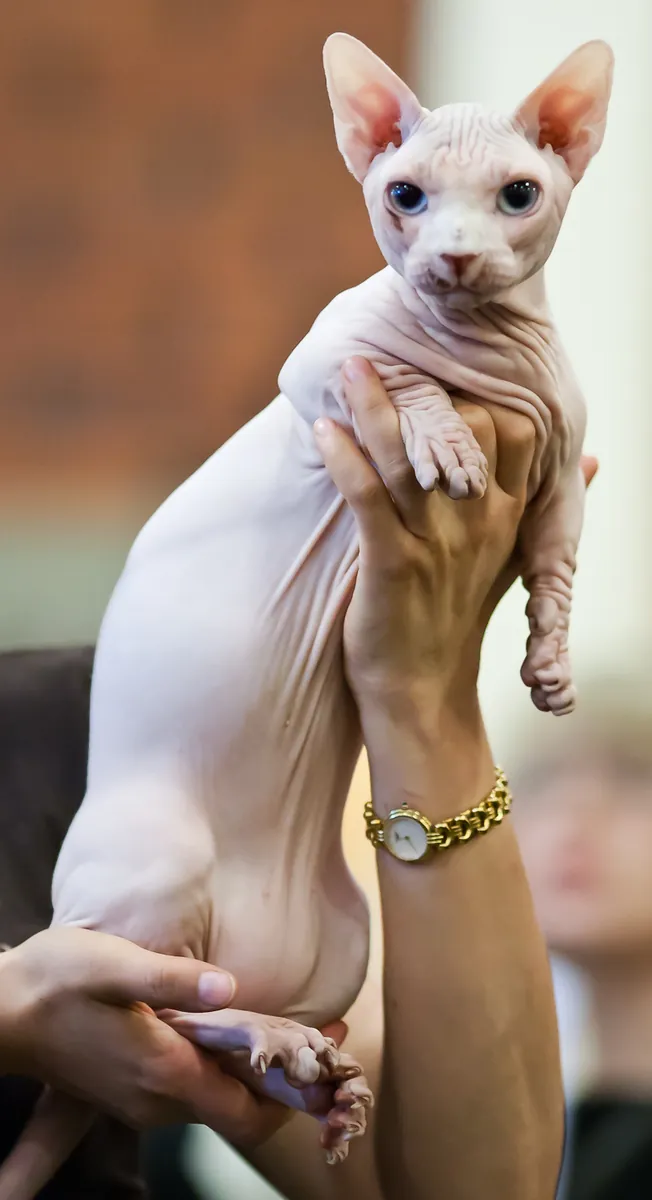
The photo on its profile is of a male shown at a TICA show in Finland in 2010.
Frequently asked questions
How big does a Bambino get?
An adult Bambino usually weighs 2–4 kg (4–9 lb) and stands about 13–18 cm (5–7 in) at the shoulder, which makes it a small cat.
How long does a Bambino live?
Its usual life expectancy is 12–14 years. Living indoors, being neutered and having regular vet check-ups make the biggest difference.
Is the Bambino hypoallergenic?
No. It produces the usual cat allergens. If someone at home is allergic, spend time with the breed before deciding and talk to an allergist.
Is the Bambino good with children?
Usually yes: it tends to be patient and sociable with children. As with any cat, teach children to let it walk away when it has had enough.
How much play does a Bambino need?
As a guide, 20 min of play a day. Its activity score is 3 out of 5: short daily play sessions with a wand toy work better than one long one.
Similar breeds
All breeds A to Z Cost calculator (Spanish) Food portions (Spanish)