
How many toes does a cat have? The usual 18 and polydactyl cats
A typical cat has 18 toes: five on each front paw (one of them, the dewclaw, set higher up) and four on each back paw. Polydactyl cats have extra toes, mostly on the front paws, because of an inherited genetic mutation, and they usually live perfectly happily with them.
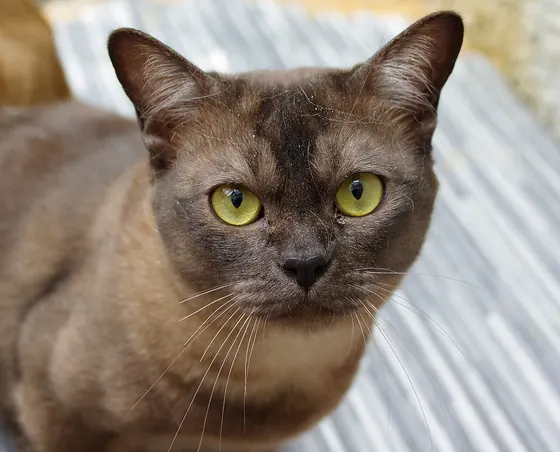
Five at the front, four at the back
If you look at your cat’s front paw you will see four toe pads resting on the ground and, a little higher up on the inner side, a fifth toe that does not reach the ground: this is the dewclaw, the equivalent of our thumb. The back paws have four toes and no dewclaw. That makes 18 toes in all, each with its own retractable claw. As well as the toe pads, each paw has a large central pad, and the front paws have one more, the carpal pad, set further up at the back, which helps the cat brake when it lands from a jump.
What the dewclaw is for
The dewclaw is not a useless leftover. It carries a strongly curved claw that the cat uses to hold prey, grip when climbing and hang on to toys, and it is often the one that snags your clothes the most. Because it does not touch the ground or wear down when the cat scratches horizontally, it is the claw most prone to overgrowing, especially in older, less active cats. If it is not trimmed, it can curl round until it digs into the pad, a painful problem that vets see often. That is why it is worth checking every few weeks, even if the other claws look after themselves.
Paw pads: much more than a sole
The paw pads are one of the most sensitive parts of a cat’s body. They have many nerve endings that tell it about the texture, temperature and vibrations of the ground, which is why many cats dislike having their paws touched. They also contain sweat glands, the only significant ones a cat has, which are triggered mainly by stress: vets see this every day in the damp paw prints left on the consulting table. And they hold scent glands that mark territory every time the cat scratches. Pad colour usually matches the coat: pink in white cats, black in black cats and mottled in tortoiseshells. A cut, a burn from hot tarmac in summer or an inflamed pad soon becomes obvious, because the cat avoids putting weight on it.
What polydactyly is
A polydactyl cat has more toes than normal. Most often the extra toes are on the front paws, sometimes giving them a mitten-like look or a broad thumb, and less often on the back paws too. The best-known cause is a mutation in a region of DNA that regulates a gene involved in limb development. It is inherited as a dominant trait: one parent having it is enough for some of the kittens to be born with extra toes. It does not depend on sex, colour or breed, and it can turn up in any ordinary moggy.
Hemingway’s cats and the sailors
Polydactyly is particularly common in some parts of the east coast of North America, such as New England and eastern Canada, and in parts of the United Kingdom. A much-repeated explanation is that sailors kept cats on board to control mice and that polydactyl cats were considered good hunters and lucky, which would have spread the mutation from port to port; it is a plausible story, though hard to prove. The most famous are the cats at Ernest Hemingway’s house in Key West, Florida, where dozens of cats live today, many of them polydactyl and, according to tradition, descended from a cat given to the writer. That is why in English they are sometimes called Hemingway cats.
The record: 29 toes
Guinness World Records keeps the record for the most toes on a cat. For more than two decades it was held by Jake, a cat from Ontario, Canada, with 28 toes, seven on each paw, counted by a vet on 24 September 2002. According to the current Guinness entry, the record is now held by Erebus, a cat from Kaukauna, Wisconsin (United States), with 29 toes, verified on 13 May 2026. These are extreme cases: a typical polydactyl cat has one or two extra toes on each front paw, for a total of between 20 and 24 toes.
Does it affect the cat at all?
In the vast majority of cases, no. Polydactyl cats walk, climb and jump normally, and many are very skilful at using their broad paws to pick things up. What they do need is a little more attention to their claws: the extra toes sometimes have awkwardly angled claws that do not wear down with scratching and can grow into the pad or become ingrown. Checking and trimming them every few weeks is enough. There are rare forms of paw malformation, different from ordinary polydactyly, that can cause bone problems; if you notice your cat limping or placing a paw oddly, have the vet take a look.
Polydactyly and breeds
Historically, polydactyly was quite common in the Maine Coon, which originates precisely in New England, and in the breed’s early days many cats had it. Over time most cat registries excluded it from the breed standard, and today show Maine Coons usually have normal toes, although some breeders keep polydactyl lines and the odd registry accepts them. There is also a breed built around the trait, the Pixie-bob, whose standard allows extra toes. But there is no need to look for a breed: polydactyl moggies turn up now and then in Spanish rescue shelters, as healthy and charming as any other cat.
A cat has 18 toes: five on each front paw, including the dewclaw, and four on each back paw. Polydactyl cats have extra toes because of a dominant mutation and live normally; they just need closer attention to their claws. The current Guinness record is 29 toes (Erebus, United States, 2026), following Jake’s 28 (Canada, 2002).
Educational content from Michipedia, translated from the Spanish original. It does not replace the advice of a vet or a feline behaviour specialist. Every cat is an individual.